Telegram vs WhatsApp for Business: Which Is Better for Sales and Customer Service?
WhatsApp wins on reach, while Telegram wins on large communities and free bots. Compare them on customer identity, broadcasts, communities, automation, cost and messaging rules, then decide when to use one or both.

Antonio Kurniawan
Product & Customer Success

On this page
- A quick comparison
- When WhatsApp is the better choice
- When Telegram is the better choice
- Messaging rules you need to understand
- Cost: free is not always cheap
- Using both: an effective split of roles
- Managing both in one inbox
- Security and privacy: what is the difference?
- The everyday customer experience
- Example: an online coding course
- Questions that help you decide
- Moving an audience from one platform to another
- Common mistakes
- Summary
Key takeaways
- WhatsApp wins on customer reach in Indonesia and suits being your main service and sales channel.
- Telegram wins for large communities, channels with unlimited subscribers and free bots through BotFather.
- The WhatsApp Business API uses approved templates and per-message charges for certain categories, while Telegram bots are free but cannot start chats.
- Many businesses use both: WhatsApp for transactions and follow-up, Telegram for community and content.
- Manage both in one inbox so customers get the same service wherever they reach you.
Telegram vs WhatsApp for business is not about which is more advanced, but about where your customers are and what you need to do after the first conversation. WhatsApp wins on reach: almost every customer in Indonesia uses it, which makes it ideal as your main channel for service, transactions and follow-up. Telegram wins for large communities, channels with unlimited subscribers and bots you can create for free through BotFather. For many businesses, the answer is not choosing one but using both with different roles and managing them in one inbox.
This article compares the two in practical terms, then explains when to use WhatsApp, when to use Telegram and how to run both without overloading your team.
A quick comparison
When WhatsApp is the better choice
WhatsApp is the main choice when:
Your customers are the general public. Online shops, clinics, restaurants, home services and most small businesses serve customers who almost all use WhatsApp.
You need follow-up after a transaction. Order confirmations, appointment reminders and shipping updates can be sent with approved WhatsApp Business API templates.
You run Click to WhatsApp ads. Meta ads can open a WhatsApp chat directly and give you the customer's number for a long-term relationship.
Trust matters a lot. A verified business number and an official business profile help customers feel safe.
The basics of using WhatsApp for business are in What is the WhatsApp Business API.
When Telegram is the better choice
Telegram is a strong choice when:
You are building a large community. Telegram groups can hold very large numbers of members, with topics to separate discussions.
You share regular content with a wide audience. Telegram channels have no subscriber limit and need no template for each post.
Your products are digital. E-books, templates, courses or content subscriptions are easy to distribute through bots or channels.
Your audience values privacy. Customers can reach you through a username without sharing a phone number.
You want automation with a low upfront cost. Telegram bots are free to create and can connect to customer service platforms.
The full picture of Telegram's business features is in Telegram for business.
Messaging rules you need to understand
Messaging rules are the difference people most often forget when choosing a platform.
The WhatsApp Business API distinguishes between customer-initiated and business-initiated conversations. When a customer has just messaged, the business can reply freely within a 24-hour window. Outside that, the business must use a Meta-approved template. Marketing and utility templates are charged at Meta's rates, under rules that can change. Details are in WhatsApp API per-message pricing.
Telegram bots cannot start a conversation. The user must tap Start or send a message first. After that, the bot can reply and send messages within certain rate limits. For broadcasting to people who have never chatted with the bot, use a channel.
These differences shape your strategy. On WhatsApp, you can contact past customers with templates for offers or reminders, as long as they gave consent. On Telegram, you rely on channels for broadcasts and bots for customer-initiated conversations.

Cost: free is not always cheap
Telegram bots and channels are free, but the real cost includes your team's time. If your customers are not on Telegram, building an audience there can cost more than paying WhatsApp message charges. On the other hand, for businesses that already have a community on Telegram, the low cost is a real advantage.
For WhatsApp, small businesses can start with the free WhatsApp Business app. When the team grows and needs many agents, official broadcasts and automation, the WhatsApp Business API becomes the option, with per-message charges for certain categories. The difference between the app and the API is covered in WhatsApp Business app vs API.
Using both: an effective split of roles
Many successful businesses use WhatsApp and Telegram together with clear roles:
The key is not to force customers to switch channels without a reason. Serve them where they chose to reach you, and only use another channel when it clearly benefits the customer.
Managing both in one inbox
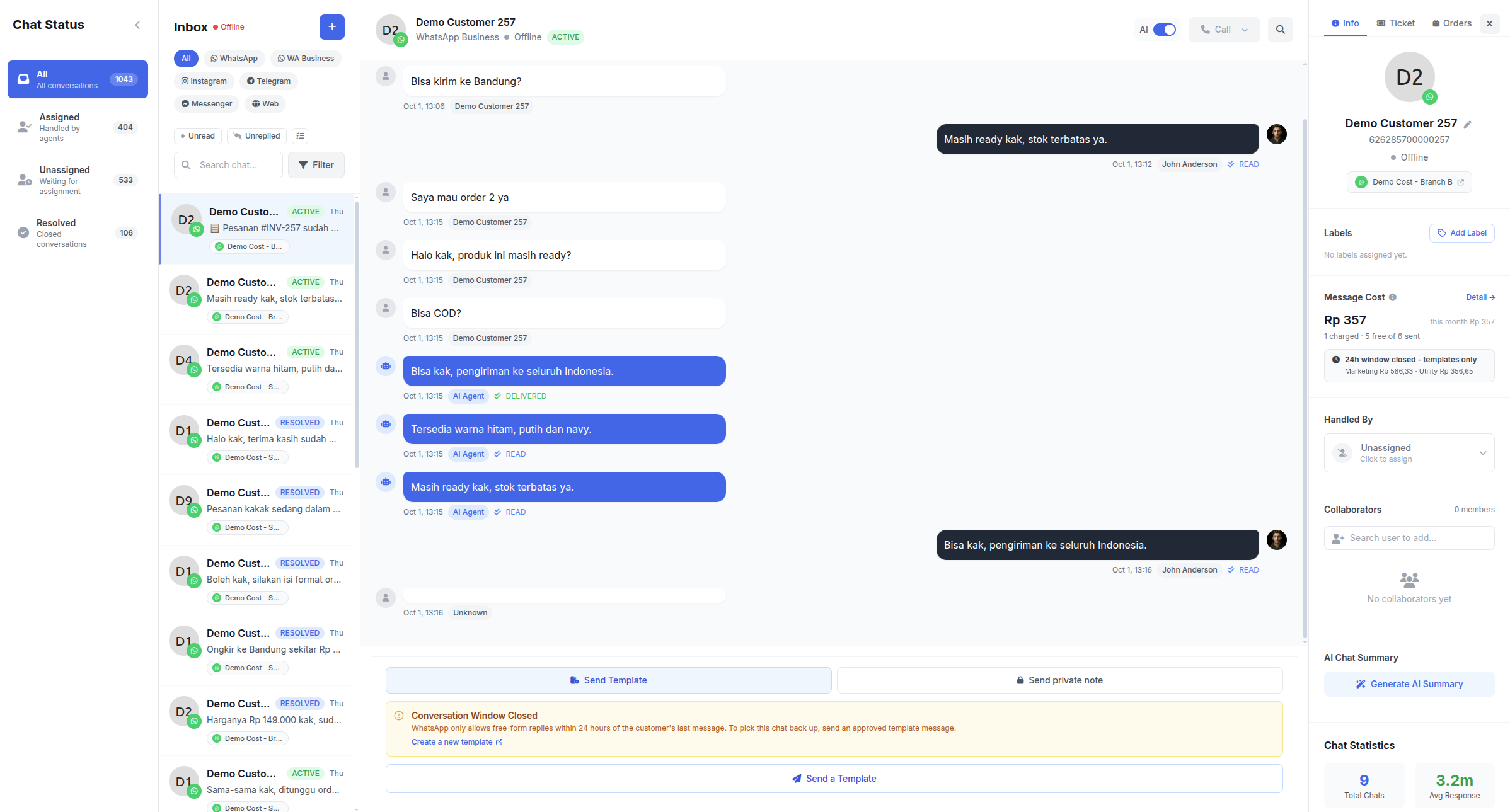
Running two platforms in separate apps overloads the team: switching apps, scattered customer history and reports that are hard to combine. An omnichannel inbox solves this.
In ChatMo, WhatsApp numbers and Telegram bots connect to one shared inbox, together with Instagram, Facebook and webchat. Chats from every channel are assigned automatically with the same rules, labelled the same way and can be answered by the same AI agent. Performance reports count response times and chat volume across channels, so the owner sees the full picture.
Security and privacy: what is the difference?
Security and privacy often matter to customers, especially in finance, health or consulting. WhatsApp uses end-to-end encryption for conversations between users, and business messages handled through official providers fall under WhatsApp's business policies. Telegram offers username-based identity so customers do not need to share a phone number, and conversations with bots are handled by the bot owner's system.
For a business, what matters more is how you handle customer data after the conversation. Limit who can see conversations, never ask for sensitive data in chat and keep customer data in systems with controlled access, not on agents' personal phones. In Indonesia, personal data handling is also governed by the Personal Data Protection Law. More detail is in customer chat data and Indonesia's PDP Law.
The everyday customer experience
Beyond features, consider how customers experience your service. On WhatsApp, customers are used to fast, personal conversations, as if talking to a friend. They expect replies within minutes, especially when asking about price or stock. On Telegram, customers active in communities are often more patient and used to searching the channel or group for answers before asking.
These habits shape how you design service. On WhatsApp, focus on reply speed and personal replies. On Telegram, use channels and group topics to answer common questions openly, so customers find answers without waiting for an agent, then provide a bot for personal matters.
Example: an online coding course
An online coding course started with WhatsApp only. Its WhatsApp groups for students filled up quickly, and course announcements got buried among chatter. They then created a Telegram group with a topic per class for student discussions, and a Telegram channel for schedule announcements and extra materials.
Registration, payment and schedule reminders stayed on WhatsApp, because prospects from ads and referrals were more comfortable there. A Telegram bot was added for students who wanted to ask admin questions without leaving Telegram. All private chats from WhatsApp and the Telegram bot land in one inbox, so the admin team does not need to watch two apps.
Questions that help you decide
If you are still unsure, answer these questions:
Which app do most of your customers use every day?
Do you need to contact customers again after a transaction, for example for reminders or repeat purchases?
Do your customers want to interact with each other in a large community?
Are your products digital and easy to deliver through chat?
How much team time is available to manage a new channel?
If the answer to the first question is WhatsApp and you need follow-up, start with WhatsApp. If community and content are central to your business, Telegram is worth adding.
Moving an audience from one platform to another
Sometimes a business wants to invite WhatsApp customers to a Telegram channel or group, for example for a community or regular content. Do it by offering a clear reason, not just asking. Offer something available only on Telegram, such as exclusive materials or discussions with an expert, and let customers choose. Customers who do not want to move are still served on WhatsApp as usual. This keeps relationships healthy and fills your Telegram community with people who are genuinely interested.
Common mistakes
Choosing a platform because it is free, not because customers are there. You cannot serve an audience that is not present.
Forcing customers to switch channels. Customers forced to move often do not continue.
Managing two platforms in separate apps. History gets scattered and the team is overwhelmed.
Assuming Telegram bots can broadcast to anyone. Bots can only message users who started a chat.
Sending WhatsApp promotions without consent. The risk of a banned number rises.
Summary
WhatsApp wins on reach and suits transactions and follow-up.
Telegram wins for large communities, channels and free bots.
Understand the messaging rules: templates and the 24-hour window on WhatsApp, bots that cannot start chats on Telegram.
Use both with clear roles if your customers are spread across the two platforms.
Manage everything in one inbox so service stays consistent and measurable.
Frequently asked questions
Which is better for business, Telegram or WhatsApp?
It depends on your customers and goals. WhatsApp is better for reaching the general public in Indonesia and handling transactions. Telegram is better for large communities, digital products and audiences comfortable with usernames.
Is Telegram cheaper than WhatsApp for business?
Creating Telegram bots and channels is free. The WhatsApp Business app is also free, but the WhatsApp Business API charges per message for certain template categories at Meta's rates, plus the platform fee.
Can Telegram bots send broadcasts like WhatsApp?
Telegram bots can only message users who have started a conversation with them. For broadcasting to many people, a Telegram channel fits better. The WhatsApp Business API uses Meta-approved templates for broadcasts.
Do Telegram customers have to share their phone number?
No. Telegram users can communicate through a username and hide their phone number, unlike WhatsApp, which is based on phone numbers.
Can WhatsApp and Telegram be managed in one place?
Yes, with an omnichannel inbox such as ChatMo that connects WhatsApp numbers and Telegram bots to one shared inbox with the same chat assignment and reports.
About the author
Antonio Kurniawan
Product & Customer Success
The ChatMo product and customer success team helps Indonesian businesses run WhatsApp, Instagram and webchat conversations with AI agents and shared inboxes.