40 Customer Service Chat Script Examples: Openers, Complaints and Closings
The right words make customers feel heard, even through a screen. Here are more than 40 customer service phrases for WhatsApp, Instagram and live chat, grouped by situation, plus the phrases to avoid.

Antonio Kurniawan
Product & Customer Success

On this page
- Principles for writing customer service replies on chat
- 1. Opening lines
- 2. Understanding what the customer needs
- 3. Asking the customer to wait
- 4. Delivering unwelcome news
- 5. Handling complaints
- 6. Saying no politely
- 7. Recommendations and gentle upsells
- 8. Asking for customer details
- 9. Closing lines
- 10. Follow-ups
- A complete example: from complaint to resolution
- Tone: casual or formal?
- Phrases to avoid
- Saving phrases as quick replies in ChatMo
- Training new agents with standard phrases
- Adjusting phrases for each channel
- Conclusion
Key takeaways
- A good reply pattern: greet by name, understand the issue, give a solution or next step, then close by offering more help.
- When asking customers to wait, always give a time estimate and keep it.
- Handle complaints in four steps: acknowledge, apologize, solve and give a time frame.
- Replace negative phrases like "we can't" with "what I can do is...".
- Save frequently used phrases as quick replies so the whole team writes in the same voice.
Good customer service wording on chat is short, friendly and answers directly: greet the customer by name, show you understand the issue, give a clear solution or next step, then close by offering more help. Unlike a phone call, customers on chat cannot hear your tone of voice, so word choice decides whether a message feels warm or cold. This article has more than 40 ready-to-use phrases for WhatsApp, Instagram and live chat, grouped by situation.
Save these phrases as quick replies so your whole team writes in the same voice and can reply faster without sounding like a robot.
Principles for writing customer service replies on chat
One message, one idea. Long messages are rarely read to the end. Break important information into points.
Use the customer's name when you know it. It is a simple signal that they are being heard.
Match your brand's tone. A casual tone fits lifestyle brands; a more formal one suits financial or B2B services. Consistency is what matters.
Emojis in moderation. One emoji can soften a message, but avoid them when the customer is angry.
Always give the next step. Customers should know what will happen and when.

1. Opening lines
"Hi {name}, thanks for contacting Our Store. How can I help?"
"Good morning {name}, I am Rina from the customer care team. Happy to help."
"Hi there! Thanks for waiting. Let me look into your question."
"Hi, thanks for reaching out on Instagram. Which product are you looking for?"
"Hi {name}, great to hear from you again. How can I help with your order this time?"
2. Understanding what the customer needs
"So I can recommend the best fit, what will you be using it for?"
"Which city should we ship to? I will check the shipping cost and delivery estimate."
"If you do not mind me asking, what budget range do you have in mind? I will pick suitable options."
"Could you send a photo or your order number? That way I can check faster."
"Is there a particular date you are working towards? I will help match the schedule."
3. Asking the customer to wait
"Sure, let me check with the warehouse. Please give me about 5 minutes."
"Thanks for waiting. I am still checking with the shipping team and will update you by 3 pm at the latest."
"I need to confirm this with our technical team. I will get back to you today before 5 pm."
"Sorry for the longer wait. Here is the information you asked about:"
Tip: always give a time estimate and keep it. "Just a moment" with no time frame leads to chaser messages that lengthen your queue.
4. Delivering unwelcome news
"Sorry, size M in this color is out of stock. We have size L, or navy in size M. Shall I send photos?"
"We apologize: delivery is running 1-2 days late because of a parcel surge at the courier. Your tracking number stays the same and you can follow it here: {link}."
"Unfortunately that promotion ended yesterday. Instead, there is 10% off the same product until Sunday."
"We do not ship internationally yet. May I let you know through this chat once we do?"
5. Handling complaints
Use a simple pattern: acknowledge, apologize, solve, give a time frame.
"I understand this must be disappointing. Sorry for the trouble. Could you send a photo of the product so I can process a replacement today?"
"Thanks for telling us directly. This mistake is on our side, and I will make sure the replacement ships tomorrow morning."
"I have logged your complaint as ticket {number}. Our team will contact you within 24 hours."
"I am sorry about this experience. I am passing it to my supervisor so it can be handled faster."
"We have refunded the amount to your account. It usually arrives within 1-3 working days depending on your bank. Is there anything else I can help with?"
6. Saying no politely
"Sorry, that is already our best price. But orders of 3 pieces get free shipping. Shall I calculate it for you?"
"Under our policy, returns can be processed up to 7 days after delivery. For this order, I can help you claim the manufacturer's warranty."
"For account security, we cannot share that data over chat. Please check it directly under Account in the app."
"We cannot take on this special request yet. As an alternative, the {package name} package comes close to what you need."
7. Recommendations and gentle upsells
"Many customers who buy this also take {complementary product} so it lasts longer. Shall I add it to your order?"
"If it is for a team of more than 5 people, the {name} plan is usually cheaper. Shall I compare the prices?"
"There is a bundle this week that is 15% cheaper than buying items separately. Just letting you know."
8. Asking for customer details
"To process the delivery, could you share the recipient's full name, address and phone number?"
"For your security, please never send OTP codes or PINs to anyone, including us."
"Could you confirm your registered email? I will send the invoice there."
9. Closing lines
"Happy to help, {name}. If you have any other questions, just reply to this message any time."
"Thanks for shopping with us. We hope you enjoy the product, and see you again!"
"How was our service today? Reply with a number from 1 to 5; your feedback really helps."
"I will close this conversation for now. If the issue comes back, reply here and I will pick it up."
10. Follow-ups
"Hi {name}, has your parcel arrived? If you need help using it, I am here."
"Hi, you asked about {product} yesterday. Stock is running low, shall I hold one for you?"
"Hi, a reminder about your consultation tomorrow at {time}. Reply CHANGE if you need to reschedule."
We cover follow-up techniques that do not feel pushy in how to follow up customers on WhatsApp.
A complete example: from complaint to resolution
Customer: Hi, the tracking says my parcel was delivered but I have not received anything. Really disappointed.
Agent: Hi Dina, I understand that must be worrying. Sorry for the trouble. Could you share your order number? I will check with the courier right now.
Customer: INV-48210.
Agent: Thank you. I have contacted the courier and will update you by 2 pm today at the latest.
Agent (1:20 pm): Dina, the courier confirmed the parcel was left with your building's security desk because nobody was home. Could you check there? If it is not there, we will resend it today at no cost.
Customer: Found it, thanks!
Agent: Glad to hear it. From now on we will add a note asking the courier to call you before leaving a parcel. Anything else I can help with?
Notice the pattern: empathy in the first sentence, asking for the data you need, giving a time frame and keeping it, offering a fallback, then closing with a preventive step.
Tone: casual or formal?
Pick one tone that suits your brand and customers, then keep it consistent across every channel, including your AI agent.
Phrases to avoid
Saving phrases as quick replies in ChatMo
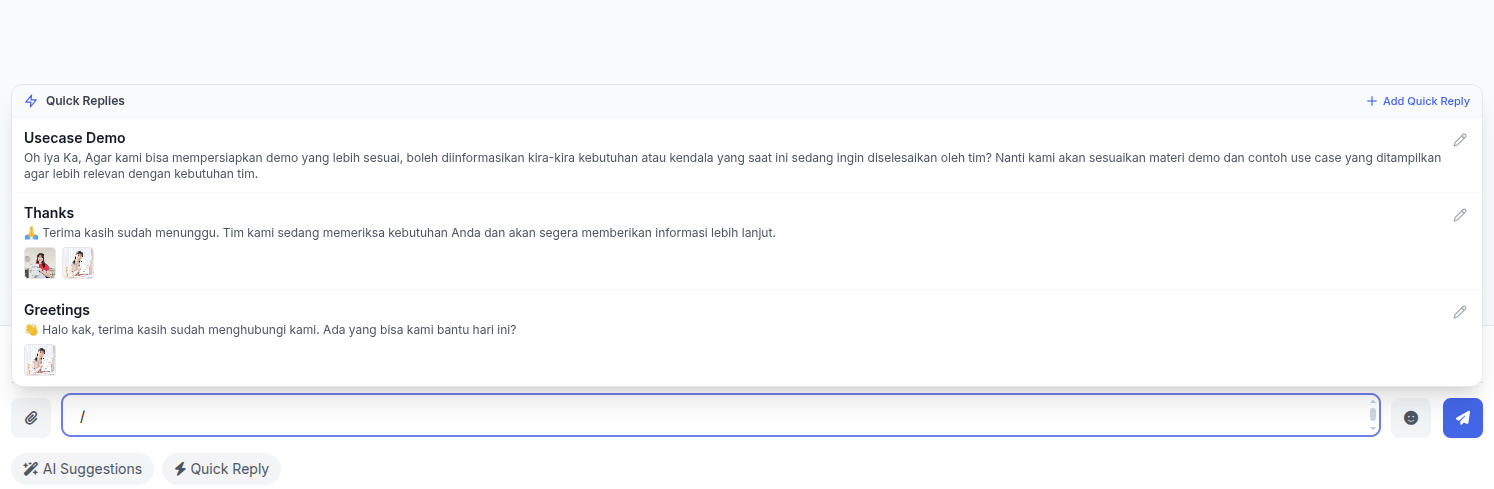
Save frequently used phrases as quick replies. Agents just type a slash / in the chat box to search and insert a reply, including attachments such as catalogs or guides. Quick replies can be shared with the whole team for a consistent voice, or kept private for an agent's own style.
If you use an AI agent, add these principles and examples to the AI persona so AI and human replies sound the same. See WhatsApp AI chatbot for customer service.
Training new agents with standard phrases
The phrases above are most useful when used to train new agents. Rather than memorizing, agents learn the pattern and the reasoning behind each phrase. A simple first-week program:
Day one: read the writing principles and the phrases to avoid, then learn the quick replies the team uses.
Day two: read 20 real conversations rated as good and 10 that fell short, then discuss the difference with a senior agent.
Day three: role-play difficult situations, such as an angry customer, a refund request and a question with no ready answer.
Days four and five: reply to real chats with support, while a senior agent reviews messages before or after they are sent.
After the first week, review a few of the new agent's conversations each week and give specific feedback. New phrases that prove effective can be added to quick replies so the whole team uses them.
Adjusting phrases for each channel
The same message can feel different across channels. On Instagram, customers expect a more casual tone and short replies with photos. On WhatsApp, slightly longer replies with clear steps work well. On website live chat, visitors are often in the middle of deciding, so answer quickly and include a link to the relevant page.
Conclusion
The right words make customers feel heard, even through a screen. Use the pattern of greet, understand, solve and close warmly. Save the examples above as quick replies, adapt them to your brand voice, and update them whenever the team finds phrasing that works better.
Want your team to reply faster with quick replies and a consistent AI agent? See the ChatMo Shared Team Inbox or book a demo.
Frequently asked questions
What is a good customer service opening line on chat?
Greet by name, mention your brand and offer help, for example "Hi {name}, thanks for contacting Our Store. How can I help?"
How should I reply to a customer complaint on chat?
Acknowledge how the customer feels, apologize, offer a clear solution and give a resolution time frame you can keep.
Which phrases should customer service avoid?
Avoid phrases like "that is not our responsibility", "as I already explained" and "we can't" without an alternative.
Can customer service use emojis?
Yes, in moderation to soften a message, but avoid them when the customer is angry or in formal services.
How do I make the whole team write in the same voice?
Save standard phrases as shared quick replies, and put the same principles into your AI agent persona.
About the author
Antonio Kurniawan
Product & Customer Success
The ChatMo product and customer success team helps Indonesian businesses run WhatsApp, Instagram and webchat conversations with AI agents and shared inboxes.