Instagram Ads to DMs: How to Create Instagram Message Ads and Handle the Leads
Ads with a messaging objective can open an Instagram DM straight from the feed, Stories or Reels. Learn when this format fits, how to build it in Ads Manager, how to write starter questions, how to handle incoming DMs and how to measure cost per order.

Antonio Kurniawan
Product & Customer Success
On this page
- When do ads to Instagram DMs fit best?
- Preparation before advertising
- Steps to create an ad to Instagram DMs
- Creative that sparks DMs
- Writing starter questions
- Handling ad DMs
- Measuring results through to orders
- Retargeting people who have already engaged
- Scheduling ads around team capacity
- Writing a first reply that leads to a purchase
- Example: a hijab brand in Solo
- Following up DMs that have not decided
- Common mistakes
- Summary
Key takeaways
- Instagram message ads open a DM straight from the feed, Stories or Reels, so prospects can ask without searching for your profile.
- The format fits products that need advice, recommendations or customisation before purchase.
- Reels and Stories creative that feels like normal content often beats overly polished ad designs.
- Specific starter questions bring quality DMs and speed up agents' work.
- Ad DMs must be answered within minutes and labelled by source so cost per order can be calculated.
Instagram ads to DMs are Meta ads with a messaging objective that open an Instagram Direct conversation with your business account. Prospects see the ad in the feed, Stories or Reels, tap Send Message and land in a DM with starter questions you prepared. To build one in Meta Ads Manager: choose a campaign objective that supports messages, set Instagram as the destination messaging app, set the audience and Instagram placements, upload the creative and write starter questions. Success depends on two things that are often overlooked: the quality of the starter questions and how fast agents reply.
This guide covers when Instagram DM ads work best, how to build them, creative that sparks conversations, how to handle DMs and how to measure results through to orders.
When do ads to Instagram DMs fit best?
Messaging ads work best for products or services that make people want to ask before buying. A few examples:
Fashion and hijab, because buyers ask about size, fabric and color.
Skincare and cosmetics, because buyers want recommendations for their skin type.
Clinics and salons, because prospects want schedules, prices and expected results.
Courses and classes, because parents or students want schedules and content.
Custom products, such as cakes, souvenirs or furniture, whose price depends on the order details.
For cheap impulse products, ads that go straight to checkout may be more efficient, because every conversation takes agent time.
Preparation before advertising
Make sure your Instagram account is professional and connected to a Facebook Page and an ad account in your Business Portfolio. The guide is in how to create an Instagram business account. Tidy your profile, because prospects often open it before or after sending a DM: a clear bio, review highlights and well-kept recent posts.
Equally important: prepare people and systems to reply. Decide who owns DMs while ads run, prepare saved replies for common questions and consider an automatic reply or AI agent for evenings.
Steps to create an ad to Instagram DMs
Open Meta Ads Manager and create a new campaign.
Choose an objective that supports message conversations, such as Engagement or Sales with messaging as the conversion location.
At the ad set level, choose the messaging app and tick Instagram as the destination. You can select several apps, but keeping Instagram separate makes results easier to measure.
Set the budget and schedule. If the team only replies in working hours, consider scheduling the ads for the same hours.
Define the audience. Start with relevant location and age, then let the creative do the filtering.
Choose Instagram placements: feed, Stories, Reels or all of them.
Upload the creative and write short primary text.
Set up the message template: a greeting and tap-to-send starter questions.
Review, publish and tell the team the ads are live.
Creative that sparks DMs
Instagram users scroll quickly. Creative that looks too much like an ad often gets skipped. What usually works better:
Reels with a human face. The owner or a staff member explaining the product in 15 to 30 seconds feels closer than a product animation.
Before and after. Treatment, renovation or style transformations immediately make people ask "could this work for me?".
Testimonials as conversations. Screenshots of happy customer chats, with permission, feel authentic.
A question inside the video. End the video with something like "Not sure which shade suits you? Send us a photo and we'll help you choose." This gives a clear reason to send a DM.
Create three to five variations and let the data pick the winner after one to two weeks.
Writing starter questions
Starter questions are tap-to-send options shown when a prospect opens a DM from the ad. Good questions make it easy to start and give agents context.
Match the questions to the creative. An ad showing a bundle should ask about the bundle contents, not the same generic questions as every other ad.
Handling ad DMs
Ad DMs cool down faster than any other leads. Prospects tap the ad while scrolling, and their attention can move to other content within seconds. Instagram also applies the 24-hour window: businesses can reply freely within 24 hours of the customer's last message.
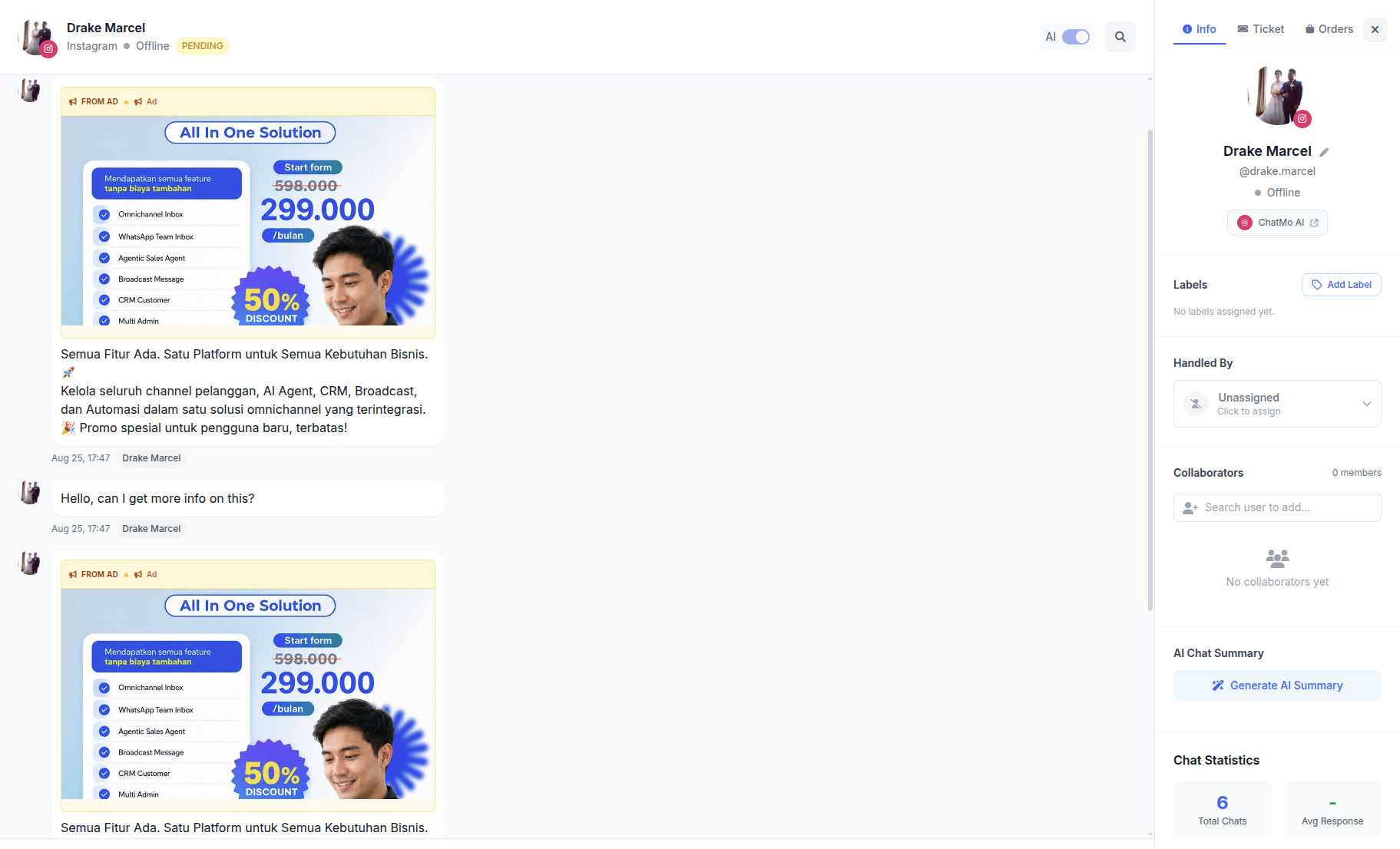
A few principles help. Reply within minutes, especially when ads are busiest. Use a useful automatic reply for busy hours, for example giving a price range and asking one key question. Assign DMs to agents automatically so nobody waits without an owner. Label every DM with its ad source. Hand over to a human agent when the customer is ready to buy or complains.
In ChatMo, Instagram DMs land in the shared inbox alongside WhatsApp and Facebook. Instagram workflows can read the first message and add labels automatically, and an AI agent can answer early questions before handing chats to agents. We cover DM auto-replies in Instagram DM auto-reply.
Measuring results through to orders
Ads Manager shows the number and cost of conversations started. To judge ads properly, also count how many DMs became qualified conversations, how many received an offer and how many paid. With source and status labels, you can calculate these numbers every week.
Send sales signals back to Meta where possible, for example through the Conversions API when a DM becomes an order. These signals help the ad system find people who actually buy, not just people who like to send messages.
Retargeting people who have already engaged
One of the most efficient ways to use DM ads is to target people who already know your brand. Meta lets you build audiences from people who have engaged with your Instagram account, such as those who watched Reels, saved posts, visited your profile or sent a DM. These people already have context, so ad conversations usually move faster toward a purchase.
Use different creative for this audience. People who do not know you need an introduction, while people who often see your content may only need a reason to ask now, such as limited stock, a new color or a time-limited offer. Keep campaigns for new and engaged audiences separate so their results can be compared clearly.
Scheduling ads around team capacity
Message ads differ from website ads: every click creates a conversation that needs a person or AI to reply. So ad schedules and budgets should follow team capacity. Work out how many DMs one agent can handle well in an hour, then set the daily budget so DM volume does not exceed what the team can manage.
If ads perform best in the evening but the team only works days, you have two options. First, add an evening shift or a part-time agent. Second, add an AI agent that answers early questions and collects information, then morning agents continue the conversations that are ready to order. The second option is usually more economical for small and mid-sized businesses.
Writing a first reply that leads to a purchase
An agent's first reply sets the direction of the conversation. Avoid replies that only answer the question and stop. Every reply should answer, add one useful piece of information and ask one question that moves the conversation a step closer to buying. For example: "Size M in sage is available. The fabric is premium voile, cool and not see-through. Do you usually wear M or L for tops?" A reply like this feels helpful and keeps the customer talking.
Example: a hijab brand in Solo
A hijab brand in Solo ran ads to Instagram DMs with a 20-second Reel showing a new instant hijab worn three ways. Starter questions: "What's the fabric and size?", "Which colors are available?" and "Is cash on delivery available in my city?".
In the first week, DMs were plentiful but orders were few, because two agents only replied in working hours while the ads peaked from 7 pm to 10 pm. They added an AI agent to answer fabric, size and color questions in the evening, and the morning agents continued the conversations that were ready to order. The share of DMs that became orders rose significantly without increasing the ad budget.
Following up DMs that have not decided
Not every ad DM ends in an order the same day. Many prospects ask, get an answer and go quiet. Send one polite, useful follow-up within 24 hours, such as a photo of someone else wearing the product, a note that stock is running low or an answer to a common doubt. Add an "Undecided" label so the team knows who to reach again when there is a restock or the next offer, as long as it stays within Instagram's messaging rules.
Common mistakes
Advertising without a team ready to reply. DMs pile up and budget is wasted.
Generic starter questions. Agents have to start from scratch.
Overly polished creative. Instagram users scroll past content that feels like a TV ad.
No source labels. You cannot tell which ads produce orders.
Judging only cost per conversation. The cheapest ad is not always the most profitable.
Summary
Ads to Instagram DMs suit products that prompt questions before purchase.
Prepare a professional account, a tidy profile and a team ready to reply.
Use natural Reels and Stories creative and write specific starter questions.
Reply within minutes, assign DMs to agents and label the source.
Measure through to orders and send sales signals back to Meta.
Frequently asked questions
What are Instagram ads to DMs?
Instagram ads to DMs are Meta ads with a messaging objective whose button opens an Instagram Direct conversation with your business account, so prospects can ask questions right away.
How do I create an Instagram ad that leads to DMs?
In Meta Ads Manager, create a campaign with an objective that supports messages, choose Instagram as the destination messaging app, set the audience and budget, select Instagram placements, upload the creative and write starter questions.
Do Instagram DM ads require a business account?
Yes. The Instagram account must be professional and connected to a Facebook Page and an ad account in your Business Portfolio.
How fast should ad DMs be answered?
Ideally within minutes. Prospects who tap the ad are usually still on Instagram, and businesses can only reply freely within 24 hours of the customer's last message.
Are ads to Instagram DMs or to WhatsApp better?
Ads to DMs suit customers who prefer Instagram and fairly short conversations. Ads to WhatsApp suit businesses that need long-term follow-up and want to keep the customer's number.
About the author
Antonio Kurniawan
Product & Customer Success
The ChatMo product and customer success team helps Indonesian businesses run WhatsApp, Instagram and webchat conversations with AI agents and shared inboxes.