How to Follow Up With Customers on WhatsApp Without Being Spammy (+15 Examples)
The right follow-up turns quiet prospects into buyers. Learn when and how often to follow up, the five types of follow-up that convert best, 15 message examples, the WhatsApp rules to know and how to automate follow-ups.

Antonio Kurniawan
Product & Customer Success
On this page
- Why follow-up often decides the sale
- When is the best time to follow up?
- How many times should you follow up?
- Five types of follow-up that convert best
- 15 WhatsApp follow-up message examples
- WhatsApp rules to keep in mind
- Automating follow-ups in ChatMo
- An example follow-up sequence for one lead
- Manual or automatic follow-up?
- Measuring follow-up results
- Common mistakes
- Follow-up etiquette: send times and tone
- Follow-up for B2C and B2B
- Conclusion
Key takeaways
- Effective follow-ups happen at the right moment, with a clear reason, and at most two or three times per topic.
- Every follow-up should bring something new: information, an answer to a doubt or a fresh reason to decide.
- On the WhatsApp API, follow-ups more than 24 hours after the customer's last message must use an approved template.
- Leads from Click-to-WhatsApp ads can be followed up for free for 72 hours if the first chat was answered within 24 hours.
- Auto follow-ups in ChatMo AI agents support a delay and either an exact message or an AI prompt, and stop when the customer replies.
Effective WhatsApp customer follow-up means getting back in touch with prospects or customers at the right moment, with a clear reason, and no more than two or three times per topic. The best follow-ups feel like help, not chasing: they answer a remaining doubt, remind people of something they actually need, or offer an easy next step. On the WhatsApp Business API, follow-ups within 24 hours of the customer's last message can be free-form, while anything later must use a Meta-approved template.
This article covers when and how often to follow up, the five types of follow-up that convert best, 15 message examples, the WhatsApp rules to watch, and how to automate follow-ups without them feeling like spam.
Why follow-up often decides the sale
Many prospects stop replying not because they lost interest, but because they got busy, forgot or still have doubts. Without a follow-up, a conversation that was close to a sale simply ends. The right follow-up:
Brings attention back to a postponed decision.
Gives people a chance to raise doubts they never asked about.
Shows your business cares, not just about the transaction.
Brings repeat purchases from existing customers, usually cheaper than finding new ones.
When is the best time to follow up?
Tip: for prospects who just asked a question, try to send the first follow-up within 24 hours of their last message. It is more relevant, and free-form messages in this window do not need a template.
How many times should you follow up?
For one topic, two or three times is enough. Each follow-up should bring something new: extra information, an answer to a doubt or a fresh reason to decide. If there is no response after three, label the contact "unresponsive" and add them to a segment to contact again months later with a genuinely new reason.
Five types of follow-up that convert best
1. After the first question
A prospect asks about price and disappears. A good follow-up does not just ask "so, are you buying?" but helps them decide: send a comparison of variants, testimonials or the answer to the question people usually ask next.
2. After a quote is sent
Ask whether any part needs explaining, and offer a short call or a package adjustment. Mention the quote's validity date if there is one.
3. Unfinished payments
Send a polite reminder with the same payment link and ask whether anything is in the way. Many delayed payments happen simply because customers forgot or were confused by the payment method.
4. After purchase
Make sure the product arrived and is being used correctly. This builds trust, prevents complaints and opens the door to reviews or repeat purchases.
5. Re-engaging past customers
Contact customers who have not bought in a while with a relevant reason: the product they usually buy is due to run out, there is a new version, or there is an offer for returning customers.
15 WhatsApp follow-up message examples
After a question
"Hi {name}, you asked about {product} earlier. Here is a comparison of the two most popular variants, in case it helps you decide."
"Hi, the size you asked about is still available. Shall I work out the shipping cost for you too?"
"Hi, yesterday you asked about the {name} package. Customers usually also ask about the warranty; this package comes with 1 year. Anything else you would like to know?"
After a quote
"Hi {name}, have you had a chance to read the proposal for {project}? If anything needs adjusting, I am happy to discuss."
"Hi, the special price for {product} is valid until {date}. Just letting you know so you do not miss it."
"Hi, would it be easier to go through this on a quick 10-minute call? Pick whatever time suits you."
Delayed payment
"Hi, order {number} is still awaiting payment. Here is the payment link again: {link}. Any trouble with the payment method?"
"Reminder: the payment deadline for order {number} is tomorrow at {time}. After that we will release the stock to other buyers."
After purchase
"Hi {name}, did your parcel arrive safely? If anything is not quite right, let us know."
"Hi, you have been using {product} for a week now. Here is a quick tip to get even better results: {tip}."
"Thanks for shopping with us. If you have a moment, could you leave a short review at this link? It means a lot to us."
Re-engagement
"Hi {name}, {product} usually runs out after about 2 months. Shall we prepare your next order?"
"Hi, there is a new version of the {product} you bought, with {improvement}. Shall I send the details?"
"It has been a while! Returning customers get a {value} voucher until {date}."
"Hi, we want to make sure our messages are still useful to you. Reply STOP if you would rather not receive messages like this."
WhatsApp rules to keep in mind
The 24-hour window. On the WhatsApp Business API, free-form messages can only be sent within 24 hours of the customer's last message. Later follow-ups must use an approved template. See WhatsApp Business message template examples.
Per-message costs. Follow-up templates are billed by category: payment reminders are usually Utility, while offers are Marketing. Details are in WhatsApp API per-message pricing.
The free 72-hour window from ads. For leads from Click-to-WhatsApp ads, follow-ups in the first 72 hours are free if the first chat was answered within 24 hours.
Respect opt-outs. Customers who ask to stop must really stop being contacted. Ignoring this is the fastest way to lower your number's quality.
Automating follow-ups in ChatMo
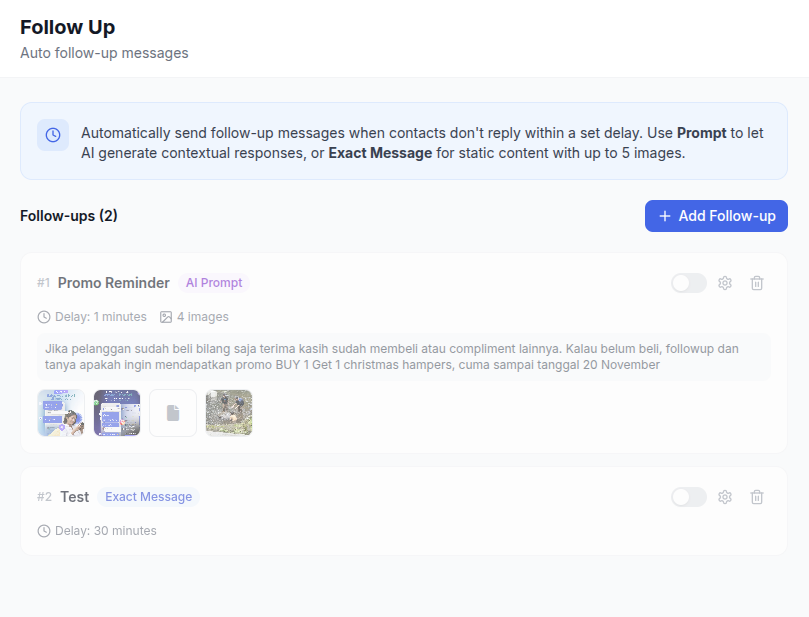
ChatMo AI agents have an Auto follow-up messages feature. You set the delay (for example 3 hours or 2 days after the customer stops replying) and choose the follow-up content type:
Exact message: the same text is sent as written. Good for reminders that must stay consistent.
Prompt for the AI: the AI writes the follow-up from the conversation context, for example "Ask whether they are still interested. If they already bought, thank them. If not, offer our buy 1 get 1 promo."
You can create several follow-ups in sequence with different delays, and they stop automatically once the customer replies.
An example follow-up sequence for one lead
Manual or automatic follow-up?
Both have their place. Automatic follow-up suits repetitive, predictable situations: price questions that went nowhere, delayed payments and post-purchase check-ins. Manual follow-up is better for high-value deals, B2B negotiations or customers with a complaint, where a salesperson's personal touch decides the outcome. Many teams automate the first follow-up, then let sales take over once the customer replies.
Measuring follow-up results
Common mistakes
Follow-ups with nothing new, just "so, are you buying?" again and again.
Too frequent, such as every day for a week.
Ignoring context, like offering the product the customer just bought.
No record of who has been followed up, so two salespeople contact the same customer.
Forgetting to stop once the customer replies or buys.
Follow-up etiquette: send times and tone
A well-written follow-up can still feel intrusive if it arrives at the wrong moment. A few simple rules keep follow-ups polite:
Send at reasonable hours, generally between 9 am and 8 pm in the customer's local time. Avoid early mornings, late nights and prayer times if your audience is sensitive to them.
Mind time zones if your customers are spread across Indonesian time zones or abroad.
Match the moment. During major holidays, greetings and service schedule updates fit better than a push to buy.
Use the customer's tone. If they write casually, an overly formal follow-up feels like a mass message.
Always give context, such as the product or offer you discussed, so the customer remembers without scrolling back.
For automatic follow-ups, set delays with send times in mind. A 12-hour delay after a late-night chat can land in the early morning, while a 1-day delay usually lands at the same time as the last conversation.
Follow-up for B2C and B2B
B2C follow-ups are short and fast: the decision is usually made within hours or days. B2B follow-ups move more slowly, involve several decision-makers and often need supporting material such as proposals, case studies or a demo. In B2B, a follow-up that offers a meeting time or answers a procurement question usually works better than a reminder alone.
Conclusion
Follow-up is the bridge between interest and decision. Do it at the right moment, two or three times per topic at most, and always bring something new. Mind the 24-hour window and template costs on the WhatsApp API, respect opt-outs, and automate repetitive follow-ups so your team can focus on the conversations closest to a sale.
Want automatic follow-ups written by AI from the conversation context? See ChatMo AI Agents or book a demo.
Frequently asked questions
When is the best time to follow up with a customer?
It depends: a few hours after a price question, 2 days after a quote, 1-3 hours after a payment link is sent, and 2-3 days after delivery.
How many times should I follow up?
Two or three times per topic, with something new in each message. Then stop and add the contact to a re-engagement segment.
Do follow-ups on the WhatsApp API need a template?
Yes, once more than 24 hours have passed since the customer's last message. Within 24 hours, follow-ups can be free-form.
How do I set up automatic follow-ups in ChatMo?
In the AI agent, turn on Auto follow-up messages, set the delay, then choose an exact message or a prompt so the AI writes the follow-up from the conversation context.
How do I keep follow-ups from feeling spammy?
Give a clear, useful reason, limit frequency, respect opt-out requests, and stop following up once the customer replies or buys.
About the author
Antonio Kurniawan
Product & Customer Success
The ChatMo product and customer success team helps Indonesian businesses run WhatsApp, Instagram and webchat conversations with AI agents and shared inboxes.